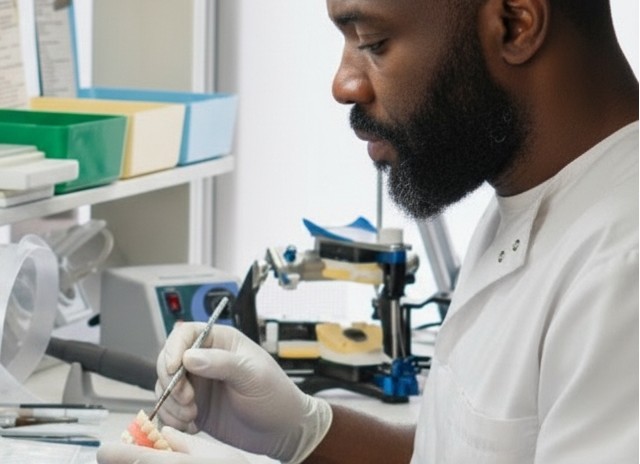
An in-house denture lab in Jacksonville FL allows denture repairs, relines and adjustments to be managed closer to the patient, dentist and laboratory technicians. At Quality Dentures & Implants, having laboratory facilities on site can mean faster communication, fewer outside-lab delays and convenient changes during suitable fitting and repair appointments.
For patients, that can mean less time without their dentures and a more efficient path back to eating, speaking and smiling comfortably.
Quality Dentures & Implants has an in-house denture lab in Jacksonville, allowing its dental team and lab technicians to work together on suitable repairs, relines and adjustments. This can shorten turnaround times, support closer quality control and potentially reduce the time and expense associated with sending dentures to an outside laboratory.
What Is an In-House Denture Lab?
An in-house denture lab is a dedicated laboratory located within the dental practice rather than at a separate, off-site facility.
It provides a controlled workspace where trained technicians can perform suitable denture work in collaboration with the treating dental team. Depending on the case, this may include:
- Repairing cracks or fractures
- Replacing a tooth that has come away from a denture
- Relining a loose denture
- Adjusting areas causing pressure or discomfort
- Refining the fit during the denture-making process
- Making changes to improve function or appearance
- Completing professional finishing and polishing
Not every procedure can be finished immediately, and not every damaged denture is repairable. However, having the laboratory on site can remove several steps that would otherwise occur when work is sent elsewhere.
What Happens When a Practice Uses an Outside Laboratory?
When a dental practice does not have its own lab, the denture may need to be packaged, transported and entered into an external laboratory’s production schedule.
Instructions must travel with the appliance, and questions or requested changes may require communication between different locations. Once the laboratory work is complete, the denture must be returned to the practice before it can be checked in the patient’s mouth.
This process can be entirely appropriate for specialised or complex work, but it may add:
- Transportation time
- External scheduling delays
- Additional communication stages
- More time without the denture
- A longer wait before further adjustments can be made
An in-house lab streamlines this process by keeping appropriate work at the practice.
Why Does Direct Communication Matter?
Dentures are highly individual. A difference of only a few millimetres can influence comfort, speech, appearance and the way the teeth meet.
When the dentist and lab technician work in the same location, they can discuss the case directly. The technician can receive clear information about the denture, the patient’s concerns and the changes being requested.
If another adjustment is required after the denture is tried in, the team may be able to respond without beginning another outside-laboratory cycle.
This close working relationship is particularly helpful when:
- A patient can identify the exact location of discomfort
- The bite needs to be checked after an adjustment
- A replacement denture tooth must be matched
- A reline needs to reflect recent changes in the gums
- A repair must preserve the existing fit
- A new denture requires refinement during fitting
How Can an In-House Lab Save Time?
The most obvious time saving is the removal of transport between the practice and an external laboratory.
For suitable cases, the workflow may look like this:
- The patient’s mouth and denture are examined.
- The cause of the problem is identified.
- The dental team records the required repair or change.
- The denture is transferred directly to the on-site technician.
- The laboratory work is completed where possible.
- The denture is returned to the patient and checked.
- Further adjustments are made if required.
Some repairs may be completed on the same day, particularly when patients attend early enough and the necessary work is suitable for immediate treatment. More complex repairs, extensive damage or new dentures may require additional time.
An assessment is necessary before any turnaround can be confirmed.
Can an In-House Lab Help Reduce Costs?
An in-house laboratory may make the denture process more efficient by reducing external handling, transport and repeated communication. It can also help the team determine whether an existing denture can be repaired or relined instead of completely replaced.
The lowest-priced option is not necessarily the one offering the best value. A professional assessment should consider the denture’s condition, age, fit and expected remaining service life.
For example, repairing a recent, otherwise sound denture may be economical. Repeatedly repairing a heavily worn denture with a poor bite may cost more over time than replacing it.
Quality Dentures & Implants can explain:
- Whether the denture can be repaired
- Whether a reline would improve its fit
- Whether an adjustment is sufficient
- Whether replacement would provide better value
- The expected cost and turnaround time
This allows the patient to make an informed decision before work begins.
What Denture Problems May Be Repaired On Site?
An on-site lab may be able to help with many common denture problems, including:
- A cracked denture base
- A denture that has broken into sections
- One or more missing denture teeth
- A loose or damaged tooth
- Areas creating rubbing or pressure
- A denture that has become loose as the gums change
- Minor changes needed during a fitting
- Finishing and polishing after appropriate repairs
The technician must examine the denture before confirming that it can be repaired. Severe distortion, extensive deterioration or repeated fractures may indicate a deeper problem with the fit or bite.
Simply joining the broken pieces without correcting the cause could lead to another failure.
Why Might a Denture Need Relining?
The gums and supporting bone naturally change after teeth are lost. Although the denture stays approximately the same shape, the mouth beneath it does not.
This can gradually create a space between the denture and gums, causing movement, trapped food, difficulty chewing or recurring sore spots.
A reline adds new material to the surface resting against the gums. It can improve the fit of an otherwise serviceable denture without replacing the complete appliance.
The American Dental Association advises that a denture that becomes loose or uncomfortable may need to be relined or replaced.
With laboratory support on site, suitable relining work can be closely coordinated between the dentist and technicians.
What Is the Difference Between a Repair, Adjustment and Reline?
These treatments solve different problems.
Denture repair
A repair restores a damaged component, such as a cracked base or missing denture tooth.
Denture adjustment
An adjustment reshapes a limited area that is causing pressure, rubbing or bite interference.
Denture reline
A reline renews the broader internal surface of the denture to improve its contact with the gums.
A denture can sometimes need more than one type of treatment. For example, a recurring crack may need repair, but an assessment may reveal that poor fit is placing excessive stress on the denture. Relining or replacement may then need to be considered.
Inside the Lab: Why DIY Repairs Cause Problems
Household glue and DIY denture kits can contaminate the repair surfaces, distort the denture or create an inaccurate fit. Some glues are not intended for use in the mouth and may make a professional repair more difficult.
If your denture breaks:
- Remove it carefully.
- Collect all broken pieces.
- Do not force the sections back together.
- Do not file or reshape the denture.
- Store it safely as instructed by the practice.
- Contact Quality Dentures & Implants promptly.
The lab technician needs the denture in the best possible condition to assess whether a reliable repair can be completed.
When Is a New Denture the Better Choice?
An in-house lab can make repairs and relines more convenient, but it cannot make every denture suitable for continued use.
Replacement may provide a more predictable result when:
- The denture teeth are extensively worn
- The base is severely damaged or distorted
- The denture has broken repeatedly
- Your bite has changed significantly
- The denture no longer supports your facial appearance
- Previous repairs have weakened the appliance
- A reline cannot create sufficient stability
- Your oral health or treatment needs have changed
The dental team will discuss the available choices rather than completing a repair that is unlikely to last.
Experience the Benefit of On-Site Denture Care
An in-house lab brings the clinical and technical sides of denture care together. It gives patients access to convenient repairs, relines and adjustments while enabling closer communication between the dentist and laboratory technicians.
Quality Dentures & Implants provides an in-house denture lab in Jacksonville FL for suitable denture work. Contact the practice to arrange an assessment if your denture is broken, loose, uncomfortable or no longer functioning as it should.
This information is general and does not replace an examination or personalised dental advice.
Frequently Asked Questions
What does an in-house denture lab do?
An in-house denture lab provides a dedicated space where trained technicians can complete suitable denture repairs, relines, adjustments, finishing and other laboratory work in close collaboration with the dental team.
Can an in-house lab repair my dentures on the same day?
Many common repairs may be suitable for same-day service, particularly when the denture can be assessed early in the day. The type of damage, required materials and current laboratory workload will determine the actual turnaround.
Is an in-house denture lab more affordable?
Keeping appropriate work on site can reduce external handling and make treatment more efficient. The final cost depends on the denture’s condition and whether it requires an adjustment, repair, reline or replacement.
Can the lab improve the fit of loose dentures?
A loose denture may be improved through adjustment or relining when the appliance remains in suitable condition. A dental examination is required to identify why it is loose and determine the correct treatment.
Does every broken denture need to be replaced?
No. Many damaged dentures can be professionally repaired. Replacement may be recommended when the appliance is extensively damaged, badly worn, repeatedly breaking or unable to provide an appropriate fit and bite.